
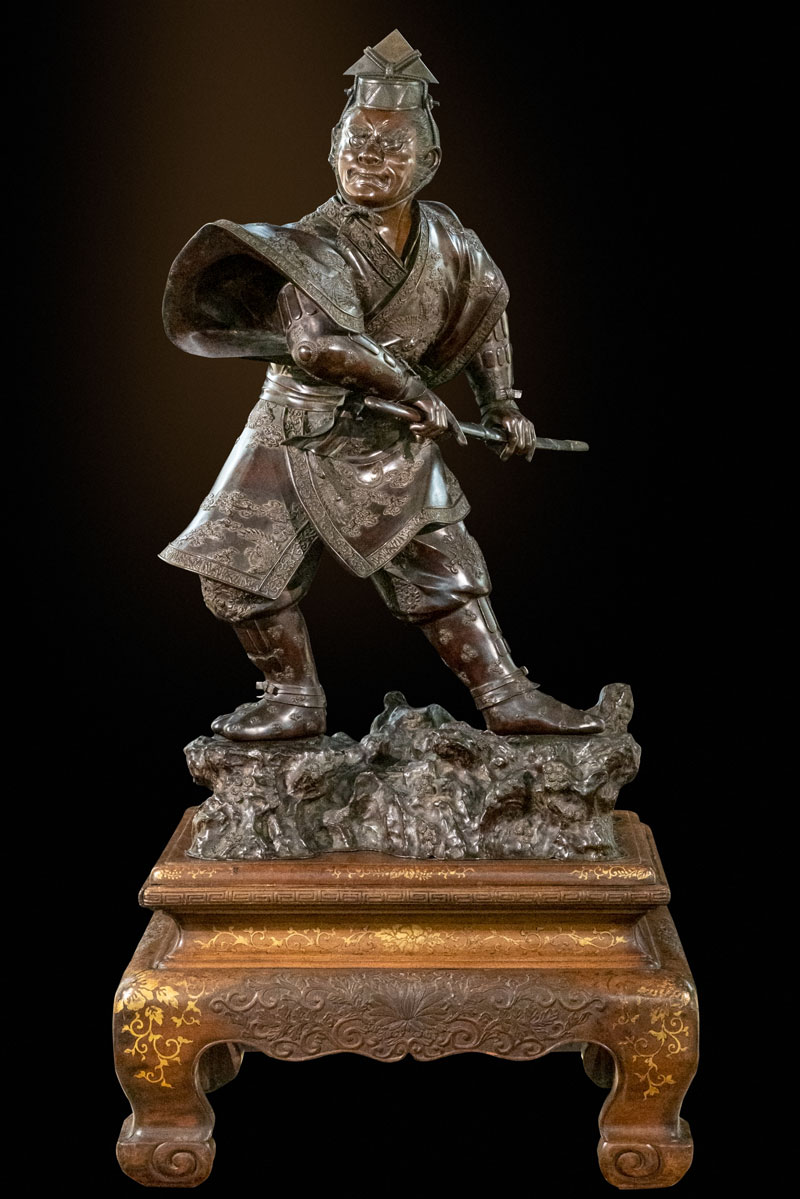
Commodore Matthew Perry (1794-1858) led two United States Navy expeditions to Japan in the 1850s to forcibly open global trade ports. “Exposition, Empire and Expression” showcases the impact over the subsequent century on Japanese artists and global art.
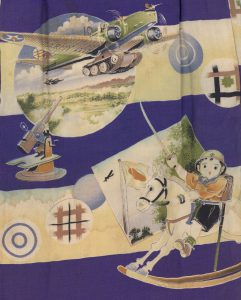
Japanese bronze artists were highlighted at various World Fairs and international expositions in Europe and North America during the late 19th and early 20th centuries. Alongside the global appetite for colorful woodblock prints, fairs also sold Japanese bronze masterworks inlaid with silver and gold to many wealthy art patrons and museums. From the early 1900s through 1940s, Japan’s industrial prowess and military forces impacted Japanese formal and everyday fashion. Iconic kimono ensembles adorned with ships, planes, trains and artillery aligned Japan’s citizens with Imperial empire-building goals in East Asia and beyond. In post-World War II Japan, avant-garde artists worked across multiple media styles and techniques to embrace global art trends such as experimental film and painting techniques like abstract expressionism.
 (pictured) “Benkei,” 1870s-1880s, Suzuki Chokichi (Japanese, 1848-1919), Japan, Meiji period (1868-1912), Bronze on wood base with gilding, 61 x 31 x 23 ½ in., Gift of Arthur I. Appleton.
“Child’s Kimono,” ca. Early 20th century, Unknown maker, Japan, Printed wool, Gift of Erik Jacobsen, Florida Institute of Technology 2021 transfer.
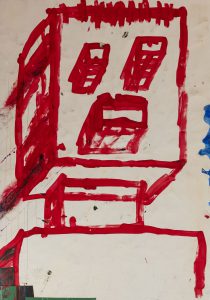
“Untitled,” 1978–1979, Hiroshi Teshigahara (Japanese, 1927–2001), Ink on paper; Mixed media on paper, Gift of the Tilton Family Collection.